Chapter 8
Logarithmic and Exponential Functions
This chapter contains logarithmic and exponential functions as a continuous study of those of logarithms and exponents of numbers from grade 10.8.1 Logarithmic Functions
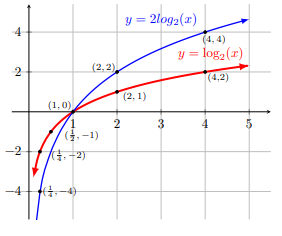
For a number b > 0, b ≠ 1, the logarithmic function y = logb x is defined as y is a number such that x = by for x > 0.The graphs of y = log2 x and y = log 1 ⁄2 x are as follows.
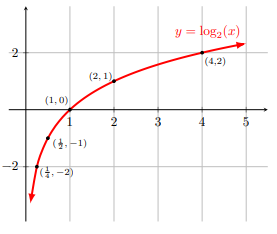
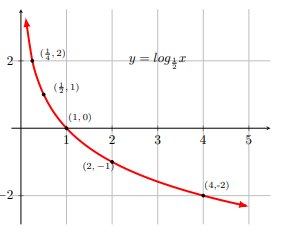
Domain of y = logbx: x > 0
Range: ℝ
Asymptote: y-axis (x = 0)
For b > 1, y = logbx is an increasing function that means if x1 > x2 then y1 = logbx1 > y2 = logbx2. For example, y = log2x is an increasing function.
For 0 < b < 1, y = logbx is a decreasing function that means if x1 > x2 then y1 = logb x1 < y2 = logbx2. For example, y = log 1 ⁄2 x is a decreasing function.
Since log 1 ⁄b x = - log b x,
$$y = \text{log}_b\, x \xrightarrow[\text{on} \, x\text{-axis}] {\text{reflection}} \, y = \text{log}_{\tiny{\dfrac{1}{b}}}\, x $$ as the graphs of y = log2x and y = log 1 ⁄2 x.
For b > 1, the graph of y = logbx is vertical scaling with scale factor 1 ⁄log2b of the graph y = log2x.
logb x = log2 x⁄log2 b so that $$y = \text{log}_2\, x \xrightarrow[\text{scale factor} \, \tiny{\dfrac{1}{\text{log}_2 b}}] {\text{vertical scaling}} \, y = \text{log}_b\, x $$
For 0 < b < 1, the graph of y = logb x is vertical scaling with scale factor 1⁄log 1⁄2 b of the graph y = 1⁄log 1⁄2 x .
$$log_b x = \frac{log_{\frac{1}{2}}x}{log_{\frac{1}{2}} b}$$ so that
$$y = \text{log}_{\tiny{\dfrac{1}{2}}}\, x \xrightarrow[\text{scale factor} \, \tiny{\dfrac{1}{\text{log}_{\tiny{\dfrac{1}{2}}} b}}] {\text{vertical scaling}} \, y = \text{log}_b\, x $$ Therefore all graphs of y = logb x are vertical scaling of the graph of y = log2 x or th graph of y = log 1⁄2 x. So as in y = log2 x and y = log 1⁄2 x, we have
| b > 1 | 0 < b < 1 |
| y = logb x < 0, if 0 < x < 1 y = logb x = 0, if x = 1 y = logb x > 0, if x > 1 |
y = logb x > 0, if 0 < x < 1 y = logb x = 0, if x = 1 y = logb x < 0, if x > 1 |
Example 1.
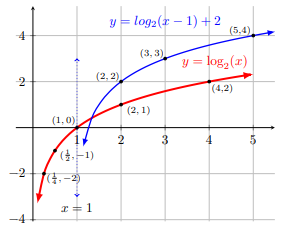
From the graph of y = log2 x, draw step-by-step transformation graph to get the graph of (a) y = log2 (x - 1) + 2
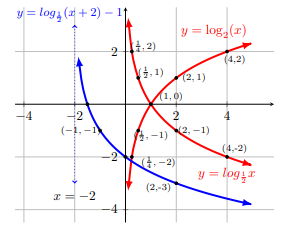
(b) y = log1⁄2 (x + 2) - 1.
Solution
$$\text{(a)}\, \, \, y = \text{log}_2 x
\xrightarrow[\text{vertical translation 2 units}] {\text{horizontal translation 1 unit}} \, y = \text{log}_2\, (x - 1) + 2 $$
$$\text{(b)} \, \, \, y = \text{log}_2\, x \xrightarrow[\text{on}\, x\text{-axis}] {\text{reflection}} \, y $$ $$ = \text{log}_{\tiny\dfrac{1}{2}}\, x \, \xrightarrow[\text{vertical translation -1 unit}] {\text{horizontal translation -2 units}} \, y $$ $$ = \text{log}_{\tiny{\dfrac{1}{2}}} (x + 2) -1$$
Example 2
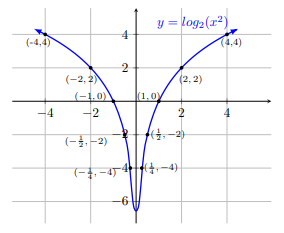
Draw the graph of y = 2 log2 x and y = log2 x2
Solution
The graph of y = 2 log2 x can be drawn directly or can be drawn as the vertical scaling with scale factor 2 of the graph of y = log2 x. Domain of y = log2 x2 is ℝ \ {0} and y = log2 x2 is an even function.
Note: Asymptote y-axis (x = 0)
Note: Asymptote y-axis (x = 0)
Note that 2 log2 x = log2 x2 for x > 0.
1. Draw the graph of
(a) y = log2(x - 2) + 1
(b) y = log2 (x + 1) - 2
(c) y = log1⁄ 2 (x + 1) + 2
(d) y = log1⁄ 2 (x - 2) - 1
2. Draw the graph of
(a) y = log1⁄ 2 x2
(b) y = log1⁄ 2 x
3. Draw the graph of
(a) y = log2(-x)
(b) y = log1⁄ 2 (-x)
4. Draw the graph of
(a) y = log2 |x|
(b) y = log1⁄ 2 |x|
8.2 Differentiation of Logarithmic Functions
Derivative of y = logb xLet y = logb x.
Let δx be a small increasement in x and δy be corresponding small increasement in y.
Then
y + δy = logb (x + δx)
δy = logb (x + δx) - logb x
= logb x + δx ⁄x
δy ⁄δx = 1 ⁄δx logb x + δx ⁄x
= logb ( x + δx ⁄x ) 1 ⁄δx
= logb (1 + δx ⁄x ) 1 ⁄δx
Let δx ⁄x = t, then 1 ⁄δx = 1 ⁄xt.
δy ⁄δx = logb (1 + t)1 ⁄xt
= 1 ⁄xlogb (1 + t) 1 ⁄t
When δx → 0, so t → 0. Then
$$\small{ \frac{dy}{dx} = \lim_{\delta x \rightarrow 0} \frac{\delta y}{\delta x} }$$ $$\small{ = \frac{1}{x} \lim_{t \to 0} log_b (1 + t)^{\frac{1}{t}} }$$ $$\small{ = \frac{1}{x} log_b (\lim_{t \to 0} (1 + t)^{\frac{1}{t}}) } $$
The following table shows
$$\small{ \lim_{t\to 0}(1 + t)^{\frac{1}{t}} = ? }$$
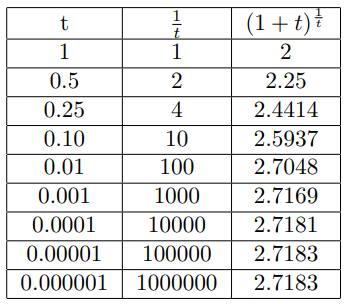
The above table shows that (1 + t)1⁄t → 2.7183 as t → 0.
This limit value is denoted by e which is called the exponential number.
In fact, e is an irrational number.
Therefore,
dy⁄dx = 1⁄x logb e
d⁄dx logb x = 1⁄x logb e
If u(x) > 0 is a function of x,
d⁄dx logb u(x) = 1⁄u(x) ⋅ logb e ⋅ d⁄dx u(x)
Logarithm of x to the base e is called natural or Napierian Logarithm and denote loge x = ln x.
Since
d⁄dx logb x = 1⁄x logb e
d⁄dx loge x = 1⁄x loge e
∴ d⁄dx ln x = 1⁄x
In general
d⁄dx ln u(x) = 1⁄u(x) ⋅ du⁄dx
Example 3.
Differentiate the following functions with respect to x
(a) log10 x3
(b) log2 x3
(c) ln x3
$$\small{ \text{(d)} \,\, \text{ln}\, \sqrt{x^2 + 5} }$$ (e) ln sin 2x
(f) ln x log10 x
$$\small{ \text{(g)} \,\, \text{ln}\, \frac{x}{\sqrt{x^2 + 2} } }$$ (h) x2⁄ log10 x
Solution
(a) log10 x3
| d⁄ dx log10 x3 | = | 1⁄ x3 log10 e d⁄ dx x3 |
| = | 1⁄ x3 log10 e . 3x2 | |
| = | 1⁄ x . x2 . 3x2 log10 e | |
| = | 3⁄ x log10 e . |
(b) log2 x3
| d⁄ dx log2 x3 | = | 1⁄ x3 log2 e d⁄ dx x3 |
| = | 1⁄ x3 log2 e . 3x2 | |
| = | 1⁄ x . x2 . 3x2 log2 e | |
| = | 3⁄ x. log2 e . |
(c) ln x3
| d⁄ dx ln x3 | = | 1⁄ x3 d⁄ dx x3 |
| = | 1⁄ x3 . 3x2 | |
| = | 1⁄ x . x2 . 3x2 | |
| = | 3⁄ x |
$$\small{ \text{(d)} \,\, \text{ln}\, \sqrt{x^2 + 5} }$$ $$\small{ \frac{d}{dx}\, \text{ln}\, \sqrt{x^2 + 5} = \frac{1}{\sqrt{x^2 + 5}} \sdot \, \frac{d}{dx} \sqrt{x^2 + 5}}$$ $$\small{ = \frac{1}{\sqrt{x^2 + 5}} \sdot \frac{d}{dx} (x^2 + 5)^{\frac{1}{2} } } $$ $$\small{ = \frac{1}{\sqrt{x^2 + 5}} \sdot \frac{1}{2} (x^2 + 5)^{- \frac{1}{2}} \sdot \frac{d}{dx} (x^2 + 5) } $$ $$\small{ = \frac{1}{\sqrt{x^2 + 5}} \sdot \frac{1}{\cancel{2}} (x^2 + 5)^{- \frac{1}{2}} \sdot \cancel{2}x } $$ $$\small{ = \frac{1}{\sqrt{x^2 + 5}} \sdot \frac{1}{(x^2 + 5)^{\frac{1}{2} }} \sdot x } $$ $$\small{ = \frac{x}{\sqrt{x^2 + 5} \sdot \sqrt{x^2 + 5}} } $$ $$\small{ = \frac{x}{x^2 + 5} } $$
(e) ln sin 2x
| d⁄ dx ln sin 2x | = | 1⁄ sin 2x. d⁄ dx sin 2x |
| = | 1⁄ sin 2x . cos 2x d⁄ dx2x | |
| = | 1⁄ sin 2x . 2 cos 2x | |
| = | 2 cos 2x⁄ sin 2x | |
| = | 2 cot 2x (∵ cos θ⁄ sin θ = cot θ) |
(f) ln x.log10 x
| d⁄ dx ln x.log10 x | = | ln x d⁄ dx log10 x + log10 x d⁄ dx ln x |
| = | ln x 1⁄ x log10 e + log10 x . 1⁄ x |
$$\small{ \text{(g)} \,\, \text{ln}\, \frac{x}{\sqrt{x^2 + 2} } }$$ $$\small{ \frac{d}{dx}\, \text{ln}\, \frac{x}{\sqrt{x^2 + 2}}= \frac{\sqrt{x^2 + 2}}{x} \sdot \frac{d}{dx} \frac{x}{\sqrt{x^2 + 2}}}$$ $$\small{ = \frac{\sqrt{x^2 + 2}}{x} \sdot \frac{\sqrt{x^2 + 2} \,\frac{dx}{dx} - x\, \frac{d}{dx}\, \sqrt{x^2 + 2}}{(\sqrt{x^2 + 2})^2} }$$ $$\small{ = \frac{\sqrt{x^2 + 2}}{x} \sdot \frac{\sqrt{x^2 + 2} \,\frac{dx}{dx} - x\, \frac{d}{dx}\, (x^2 + 2)^{\frac{1}{2}}}{(\sqrt{x^2 + 2})^2} }$$ $$\small{ = \frac{\sqrt{x^2 + 2}}{x} \sdot \frac{\sqrt{x^2 + 2} \sdot 1 - x\sdot \frac{1}{2}\, (x^2 + 2)^{- \frac{1}{2}} \sdot \frac{d}{dx} (x^2 + 2)}{x^2 + 2} }$$ $$\small{ = \frac{\sqrt{x^2 + 2}}{x} \sdot \frac{\sqrt{x^2 + 2} - x\sdot \frac{1}{\cancel{2}}\, (x^2 + 2)^{- \frac{1}{2}} \sdot \cancel{2}x}{x^2 + 2} }$$ $$\small{ = \frac{\sqrt{x^2 + 2}}{x} \sdot \frac{\sqrt{x^2 + 2} - \frac{x \sdot x}{(x^2 + 2)^{\frac{1}{2}} } } {x^2 + 2} }$$ $$\small{ = \frac{\sqrt{x^2 + 2}}{x} \sdot \frac{\sqrt{x^2 + 2} - \frac{x^2}{\sqrt{x^2 + 2} } } {x^2 + 2} }$$ $$\small{ = \frac{\sqrt{x^2 + 2}}{x} \sdot \frac{\frac{\sqrt{x^2 + 2} \,\sdot\, \sqrt{x^2 + 2} }{\sqrt{x^2 + 2}} - \frac{x^2}{\sqrt{x^2 + 2} } } {x^2 + 2} }$$ $$\small{ = \frac{\sqrt{x^2 + 2}}{x} \sdot \frac{ \frac{x^2 + 2 - x^2}{\sqrt{x^2 + 2} } } {x^2 + 2} }$$ $$\small{ = \frac{\sqrt{x^2 + 2}}{x} \sdot \frac{ \frac{2}{\sqrt{x^2 + 2} } } {x^2 + 2} }$$ $$\small{ = \frac{\cancel{\sqrt{x^2 + 2}}}{x} \sdot \frac{ 2 } {x^2 + 2 \sdot \cancel{\sqrt{x^2 + 2}}} }$$ $$\small{= \frac{2}{x(x^2 + 2)} }$$
(h) x2⁄ log10 x
| d⁄ dx x2⁄ log10 x | = | log10 x. d⁄ dx x2 - x2. d⁄ dx log10 x ⁄ (log10 x)2 |
| = | log10 x . 2x - x2 . 1⁄ x . log10 e ⁄ (log10 x)2 | |
| = | 2x.log10 x - x . log10 e ⁄ (log10 x)2 |
Logarithmic Differentiation: The derivative of positive functions can be found by taking the natural logarithm of both sides before differentiating as in the following examples.
Example 4.
$$ \small{ \text{find} \, \frac{dy}{dx} \, \text{if} \, y = \sqrt{(x^2 + 1) (x - 1)^2} } $$ Solution
$$ \small{ y = \sqrt{(x^2 + 1) (x - 1)^2} } $$ $$ \small{ \text{ln} \, y = \text{ln} \,\sqrt{(x^2 + 1) (x - 1)^2} } $$ $$ \small{= \frac{1}{2}\, (\text{ln}\, (x^2 + 1) (x - 1)^2) } $$ $$ \small{\frac{d}{dx} \, \text{ln}\, y = \frac{d}{dx}\, (\frac{1}{2}\, (\text{ln}\, (x^2 + 1) (x - 1)^2)) } $$ $$ \small{ \frac{1}{y} \frac{dy}{dx} = \frac{1}{2}(\frac{1}{x^2 + 1} \, \sdot 2x \, + \, \frac{1}{(x - 1)^2}\sdot 2(x - 1)) } $$ $$ \small{ = \frac{x}{x^2 + 1} + \frac{2}{x - 1} }$$ $$ \small{ \frac{dy}{dx} = y(\frac{x}{x^2 + 1} + \frac{2}{x - 1}) }$$ $$ \small{ = \sqrt{(x^2 + 1) (x - 1)^2} \, (\frac{x}{x^2 + 1} + \frac{2}{x - 1}) } $$
Example 5
Find dy ⁄ dx if $$\small{ y = \frac{x\,sin \,x}{\sqrt{sec\, x}}} , \, \, \, \, 0 \lt x \lt \frac{\pi}{2}. $$ Solution
$$\small{ y = \frac{x\,sin\, x}{\sqrt{sec\, x}}} , \, \, \, \, 0 \lt x \lt \frac{\pi}{2}. $$ $$\small{ \text{ln} \, y = \text{ln} (\frac{x \, sin\, x}{\sqrt{sec\, x}}) }$$ = ln x + ln sin x - 1⁄2 ln sec x
d⁄dx ln y = d⁄dx(ln x + ln sin x - 1⁄2 ln sec x)
1⁄y dy⁄dx = 1⁄x + 1⁄sin x ⋅ cos x - 1⁄2 1⁄ sec x ⋅ sec x ⋅ tan x
= 1⁄x + cot x - 1⁄2 tan x
d⁄dx = y(1⁄x + cot x - 1⁄2 tan x)
$$\small{ = \frac{x \, sin \, x}{\sqrt{sec \, x}} (\frac{1}{x} \, + \, cot \, x \, - \, \frac{1}{2} \, tan \, x) }$$
1. Differentiate the following functions with respect to x.
(a) ln (2x2 + 3)
(b) ln |x|
(c) x2 log2 x
(d) sin 3x ⋅ log10 (x + 1)
$$\small{ \text{(e)}\,\, \text{ln}\, \sqrt{5x - 4}}$$
(f) ln (ln x)
2. Use logarithmic differentiation to find the derivative of y with respect to x.
$$\small{ \text{(a)}\,\, \sqrt{x(x + 1)} }$$
(b) y = x(x + 1) (x + 2)
$$\small{\text{(c)}\,\, y = \frac{x\sqrt{x^2 + 1}}{(x + 1)^{\frac{2}{3}} } }$$
8.3 Exponential Functions
A function of the form y = bx , where b > 0, b ≠ 1, is called an exponential function of x.The graph y = 2x, y = 3x, y = 2-x, and 3-x are as follows.
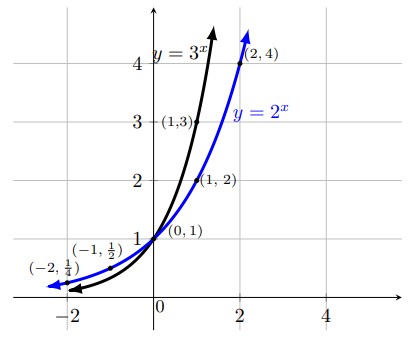
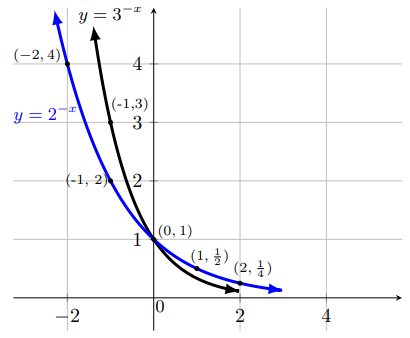
Domain of y = bx : ℝ
Range: x > 0
Asymptote: x-axis (y = 0)
Note that y = logbx and y = bx are inverse of each other.
For b > 1, y = bx is an exponential growth function as the functions
y = 2x andy = 3x.
For 0 < b < 1, y = bx is an exponential decay function as the functions y = 2-x = (1 ⁄2)x and y = 3-x = (1 ⁄3)x
$$\small{y = b^x \xrightarrow[\text{on} \, y\text{-axis}] {\text{reflection}} \, y = b^{-x} }$$
From the graph of y = bx, the graph of y = abx , a > 0 can be obtained as
$$\small{y = b^x \xrightarrow[\text{scale factor} \,a] {\text{vertical scaling}} \, y = ab^{x} }$$
From the graph of y = abx, a > 0, the graph of y = abx - h + k can be obtained as
$$\small{y = ab^x \xrightarrow[\text{vertical translation} \, k\,\text{units}] {\text{horizontal translation}\, h\, \text{units}} \, y = ab^{x - h} + k }$$ Example 6.
Draw the graph of y = 1.5 ⋅ 2x-1 - 1 from y = 2x , and y = -2-(x+1) + 2 from y = -2-x.
Solution
$$\small{y = 2^x \xrightarrow[\text{scale factor} \,1.5] {\text{vertical scaling}} \, y }$$ $$\small{ = 1.5 \sdot 2^x \xrightarrow[\text{vertical translation -1 unit}] {\text{horizontal translation 1 unit}} \, y }$$ = 1.5 ⋅ 2x-1 - 1
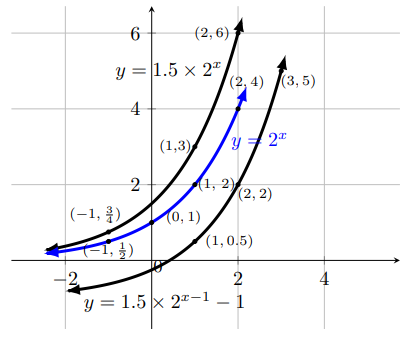
Note: Asymptote y = -1
$$\small{y = -2^{-x} \xrightarrow[\text{2 units}] {\text{vertical translation}} \, y }$$ $$\small{ = -2^{-x} + 2 \xrightarrow[\text{-1 unit}] {\text{horizontal translation}} \, y }$$ = -2-(x+1) + 2
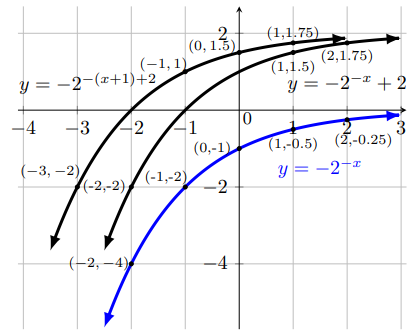
Note: Asymptote y = 2
Example 7.
Points (0,1) and (1, b) are on the graph of y = bx . Find the corresponding points on the graphs of y = abx and y = abx - h + k. What is the asymptote of y = abx-h + k ?
Find the range of y = abx-h + k if a > 0 and if a < 0.
Solutiion
$$\small{y = b^x \xrightarrow[\text{scale factor} \,a] {\text{vertical scaling}} \, y }$$ $$\small{ = ab^x \xrightarrow[\text{vertical translation}\, k \, \text{units}] {\text{horizontal translation}\, h\, \text{units}} \, y }$$ = abx-h + k
$$\small{(0, 1) \xrightarrow[\text{scale factor} \,a] {\text{vertical scaling}}\, (0,a) \xrightarrow[\text{vertical translation}\, k \, \text{units}] {\text{horizontal translation}}\, (h\,, a+k) }$$ $$\small{(1,b) \xrightarrow[\text{scale factor} \,a] {\text{vertical scaling}}\, (1,ab) \xrightarrow[\text{vertical translation}\, k \, \text{units}] {\text{horizontal translation}}\, (1+h\,, ab+k) }$$ Asymptote of y =bx is y = 0 (x-axis) and asymptote of y = abx is also y = 0 (x-axis).
After vertical translation k units, asymptote of y = abx-h + k is y = k.
If k > 0, than the range of y = abx-h + k is {y : y > k} that means all of y above the asymptote y = k.
If a < 0, then the range of y = abx-h + k is {y : y < k} that means all of y below the asymptote y = k.
1. Draw the graph of
(a) y = 2 ⋅ 3x + 1 - 2
(b) y = -2x-1 + 3
2. Draw the graph of
(a) y = 2|x|
(b) y = 2|-x|
3. Find the y-intercept, asymptote and the range of
(a) y = 3ex-1 + 2
(b) y = -2e-x+1 + 3
8.4 Differentiation of Exponential Functions
Derivative of y = bx, b > 0, b ≠ 1
y = bx, b > 0, b ≠ 1
∴ x = logb y
Differentiate both sides with respect to x,
1 = 1⁄y logbe ⋅
dy⁄dx
dy⁄dx = y ⋅
1⁄logb e = bx logeb =
bx ln b
Therefore
d⁄dx bx = bx ln b
Since ln e = 1,
d⁄dx ex = ex
and
d⁄dx eu(x) = eu(x) ⋅
d⁄dx u(x)
In general
d⁄dx bu(x) = bu(x)
⋅ ln b ⋅ d⁄dx u(x)
Example 8.Differentiate the following functions with respect to x.
(a) e3x
(b) e1-x2
(c) esin x
(d) x2e3x
(e) e2x sin 3x
(f) (ex + e-x)2
(g) 3e2x⁄1 - 2x
Solution
(a) e3x
d⁄dx e3x = e3x d⁄dx 3x
= e3x ⋅ 3
= 3 e3x
(b) e1-x2
d⁄dx e1-x2 = e1-x2 d⁄dx (1 - x2)
= e1-x2 ⋅ (-2x)
= -2x ⋅ e1-x2
(c) esin x
d⁄dx esin x = esin x d⁄dx sin x
= esin x cos x
= cos x ⋅ esin x
(d) x2e3x
d⁄dx x2e3x = x2 d⁄dx e3x + e3x d⁄dx x2
= x2 ⋅ e3x d⁄dx 3x + e3x ⋅ 2x
= x2 ⋅ e3x ⋅ 3 + e3x ⋅ 2x
(e) e2x sin 3x
d⁄dx e2x sin 3x = e2x d⁄dx sin 3x + sin 3x d⁄dx e2x
= e2x ⋅ cos 3x d⁄dx 3x + sin 3x ⋅ e2x ⋅ d⁄dx 2x
= e2x ⋅ cos 3x ⋅ 3 + sin 3x ⋅ e2x ⋅ 2
(f) (ex + e-x)2
d⁄dx (ex + e-x)2 = 2(ex + e-x). d⁄ dx (ex + e-x)
= 2 (ex + e-x).( d⁄ dx ex + d⁄ dx e-x)
= 2 (ex + e-x).(ex + e-x d⁄ dx -x )
= 2 (ex + e-x).(ex + e-x (-1) )
= 2 (ex + e-x).(ex - e-x)
(g) 3.e2x⁄ 1-2x
d⁄ dx 3.e2x⁄ 1-2x
= 3 . d⁄ dx e2x⁄ 1-2x
= 3 . (1 - 2x) d⁄ dx e2x - e2x d⁄ dx (1 - 2x)⁄ (1 - 2x)2
= 3 . (1 - 2x) e2x . d⁄ dx 2x - e2x (-2) ⁄ (1 - 2x)2
= 3 . (1 - 2x) e2x . 2 + 2e2x ⁄ (1 - 2x)2
= 3 . ((1 - 2x).2 + 2) e2x ⁄ (1 - 2x)2
= 3 . (2 - 4x + 2) e2x ⁄ (1 - 2x)2
= 3 . (4 - 4x) e2x ⁄ (1 - 2x)2
Example 9.
Find dy⁄dx .
(a) y = ex ln x
(b) y = log10 ex2
(c) y = log3(sin x + ex)
(d) xey + ln (xy) = sin x
Solution
(a) y = ex ln x
dy⁄dx = ex d⁄dx ln x + ln x d⁄dx ex
= ex ⋅ 1⁄x + ln x ⋅ ex
(b) y = log10 ex2 = x2 log10 e
log10 e = 0.4342944819 ဖြစ်သည်။ တနည်းအားဖြင့် constant ပါ။
y = x2 log10 e
dy⁄ dx = x2 d⁄ dx log10 e + log10 e d⁄ dx x2
= x2 . 0 + log10 e . 2x
= log10 e . 2x
(c) y = log3(sin x + ex)
dy⁄ dx = 1⁄ (sin x + ex) .log3 e d⁄ dx (sin x + ex)
= 1⁄ (sin x + ex) .log3 e (cos x + ex)
(d) xey + ln (xy) = sin x
Differentiate both sides with respect tox
(x d⁄ dx ey + ey dx⁄ dx) + d⁄ dx ln (xy) = d⁄ dx sin x
(x.ey. dy⁄ dx + ey.1) + 1⁄ xy. d⁄ dx (xy) =
(x.ey. dy⁄ dx + ey) + 1⁄ xy⋅(x ⋅ dy⁄ dx + y ⋅ dx⁄ dx) = cos x
(x.ey ⋅ dy⁄ dx + ey) + 1⁄ xy⋅(x⋅ dy⁄ dx + y⋅1) = cos x
x.ey⋅ dy⁄ dx + ey + 1⁄ xy⋅x dy⁄ dx + 1⁄ xy.y = cos x
x.ey ⋅ dy⁄ dx + ey + 1⁄ y ⋅ dy⁄ dx + 1⁄ x = cos x
x.ey ⋅ dy⁄ dx + 1⁄ y. dy⁄ dx = cos x - ey - 1⁄ x
(x.ey + 1⁄ y)⋅ dy⁄ dx = cos x - ey - 1⁄ x
dy⁄ dx = cos x - ey - 1⁄ x ⁄ x.ey + 1⁄ y
Example 10.
Differentiate y = xx, x > 0.
Solution
y = xx
y = eln xx
y = ex ln x
dy⁄dx = d⁄dx ex ln x
= ex ln x d⁄dx (x ln x)
= ex ln x (x ⋅ 1⁄x + ln x ⋅ 1)
= xx (1 + ln x)
1. Differentiate the following functions with respect to x.
(a) (5 + 3x)e-2x
(b) 3xx3
(c) 2x log2 x
(d) 10x log10(x + 1)
(e) x2 + tan 3x⁄ex
(f) x ln y + exy = 2
2. Given that y = e3x sin 2x, prove that d2y⁄dx2 - 6 dy ⁄dx + 13y = 0.
3. Use logarithmic differentiation to find the derivative of y with respect to x.
$$ \small{\text{(a)} \,\, y = (\sqrt{x})^x } $$
(b) y = xcos x
(c) y = (ln x)ln x